Side Panel
The budget side panel shows monthly breakdown, next-month coverage, goals, trends, and notes. Learn how to reorder and collapse sections to fit your workflow.
Written By Pedro
Last updated About 1 month ago
The panel on the right of your budget shows contextual details: either a summary of the month you're viewing or the details of a category you've clicked. You can reorder and collapse its sections to match how you actually read the page.
Two side panels
The area on the right shows one of two panels depending on what you're looking at:
- Month Overview appears by default on a freshly opened budget and summarizes the month you're viewing.
- Category Details replaces it whenever you click a category, summarizing that category for the current month.
Both share the same layout system: a stack of sections you can reorder and collapse. The order you set follows your account across devices, while which sections are open or closed is remembered per device: collapse a section on your phone without changing what you see on desktop.
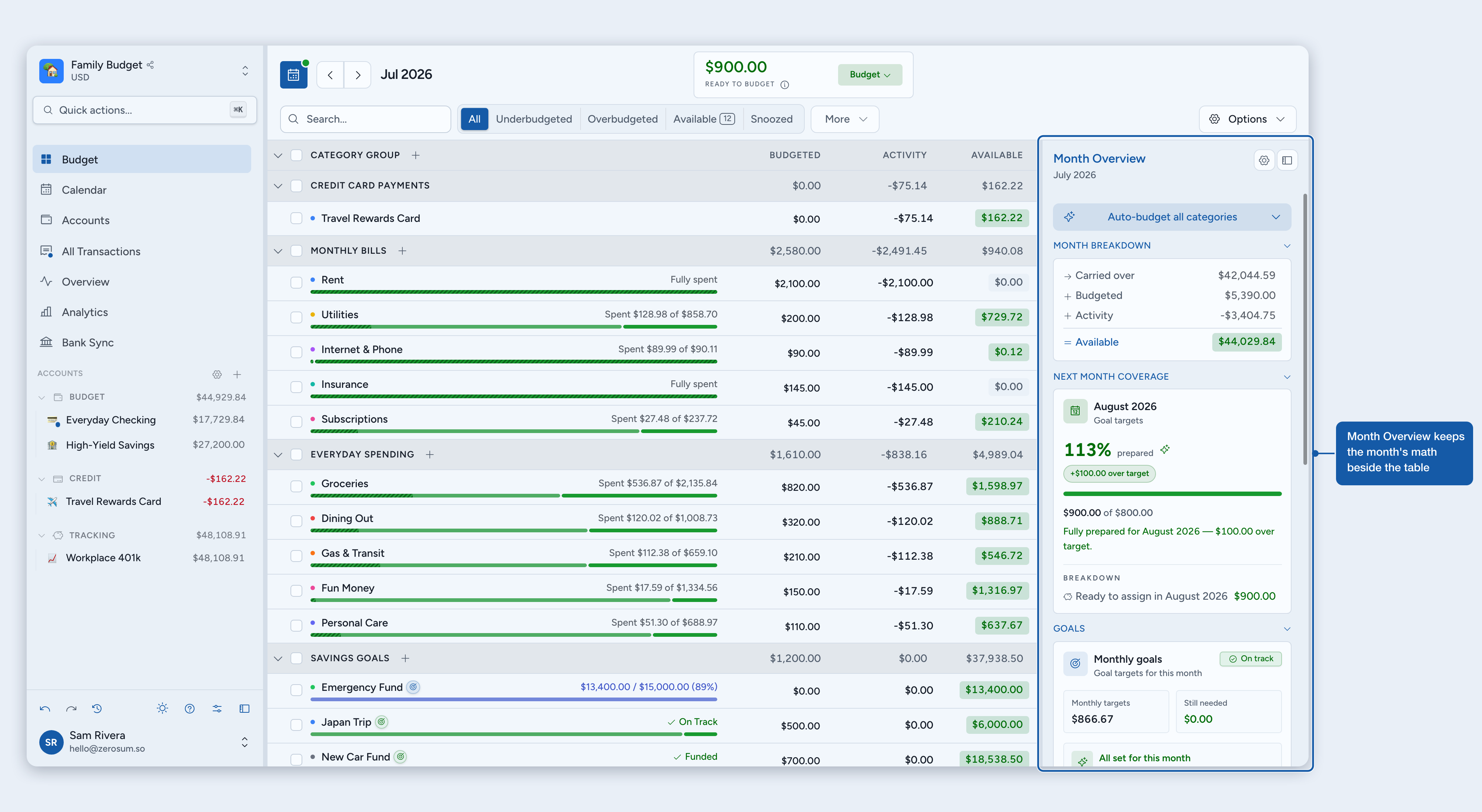
Month Overview
Sections you'll find on the Month Overview panel:
- Month Breakdown: Carried over, Budgeted, Activity, and Available for the month. If you pull money out of a category in the same month you budgeted others (for example, drawing from a buffer category), the Budgeted row splits into Budgeted to categories and Unbudgeted from categories so both directions are visible.
- Next Month Coverage: how much of next month is already prepared, measured against your goals for next month (see below).
- Goals: total monthly targets, how much still needs budgeting, and the categories making up that amount.
- Scheduled transactions: one-off and recurring activity still waiting to post, including projected repeats and scheduled-created rows waiting in Review (see below).
- Budgeting Trend: a small chart of how you've budgeted money across recent months.
- Spending Trend: a small chart of how much you've spent across recent months.
- Spending Pace: how your actual spending compares to the money you had available, at this point in the month.
- Notes: a free-form note attached to the month.
Next Month Coverage
This answers "am I set for next month?" with a headline percent prepared, a covered-of-target line, and a short coverage state sentence: how much of next month you've already lined up, measured against what it would need to be fully funded. A source label under the month name notes where the target comes from (Goal targets, Recent average, or No target yet). The same metric powers the Plan Ahead card on your Overview page.
The money it counts as lined up is anything budgeted to a category in next month, plus next month's Ready to Budget (this month's leftover that carries forward, plus anything flagged with the optional For Next Month category). Those never double-count; they're the same dollars at different stages.
Coverage state
The headline sentence tells you where next month stands. You'll see one of:
- Fully prepared. Next month is funded. If you've lined up more than the target, it also notes how much you're over.
- No funding needed. Your goals for next month already ask for nothing (for example, a Refill up to goal met by carryover). You're set.
- Left to cover. Next month is partially funded; the sentence shows how much is still left.
- Over-committed. Next month's Ready to Budget is already negative. Clear the deficit before preparing further.
- Nothing tracked yet. No goals and no recent budgeting history, so there's nothing to measure against. Add a goal to start tracking.
Target
The target is what you'd need to fully fund next month: the sum of your goal targets for next month (Budget another, Refill up to, and dated Reach a balance goals), excluding snoozed goals.
For Refill up to goals and Budget another goals with a Stop at cap, how much the target asks follows your budget's Plan future months fresh setting: plan fresh counts the full target, while carryover-aware counts only the shortfall after the balance likely to carry over. If a category has no goal, the card falls back to the average of the last three months you actively budgeted so the metric still has something to compare against.
Card states
- Covered (green): 100% funded or beyond, or funding rules already met by carryover.
- Over-committed (red): next month's Ready to Budget is already negative. Clear the deficit before adding more goals.
- In progress (neutral): partially funded; the card shows how much is left to cover.
- No target yet (neutral): no active goals and no recent budgeting history. Add a goal to start tracking.
Scheduled transactions
The Scheduled Transactions card summarizes planned account activity in the viewed month. It combines materialized scheduled rows with projected recurring occurrences, so a weekly bill that happens several times in one month is counted several times even though only the next row exists in the register.
- Outflows: total and count of planned money leaving accounts.
- Inflows: total and count of planned money entering accounts, shown when present.
- Total count badge: the combined number of scheduled occurrences.
- Next on: the earliest unresolved scheduled date in the month.
ℹ️ Scheduled intent is not the same as approval: future native scheduled rows and scheduled-created rows waiting in Review count here; ordinary unapproved bank or file imports do not. Splits count once at the whole-family amount in the month summary, while category-specific views attribute their individual lines.
These transactions do not affect balances or budget Activity until approved. For category funding warnings, scheduled inflows and outflows are netted in the category, and the warning remains while a due scheduled-created row waits in Review. Read Scheduled & recurring transactions for the complete lifecycle.
The section is hidden on past months. On a current or future month with nothing scheduled, it shows Nothing scheduled this month.
Category Details
Sections you'll find on the Category Details panel after clicking a category:
- Category Breakdown: Carried over, Budgeted, Activity, and Available for the category.
- Budgeting Trend: a small chart of how you've budgeted to this category over recent months.
- Spending Trend: a small chart of how much you've spent in this category over recent months.
- Spending Pace: how your actual spending in this category compares to the money you had available, at this point in the month.
- Goal: goal progress, or a card to set one up if the category has no goal yet.
- Upcoming Transactions: one-off scheduled rows, scheduled-created review rows, and projected recurring occurrences for the category (shown only when there are any).
- Notes: both a monthly note and a permanent note attached to the category.
Reordering sections
If you read the panel differently than the default order suggests (say, you look at Goals before the Month Breakdown), rearrange the sections to match:
- Open the Manage sections dialog. Click the gear icon at the top of the side panel header. A dialog opens listing every section in the panel.
- Drag to reorder. Grab the drag handle on any section and drop it into a new position. The order saves as soon as you drop.
- Close the dialog. Click outside it or press Escape. The panel reflects the new order immediately.
💡 Tip: The reorder dialog covers one panel at a time; its title shows whether you're editing Month Overview or Category Details, and each panel keeps its own saved order.
Collapsing sections
Every section header has a chevron on the right. Click the header (or the chevron) to collapse the section so only its title stays visible; click again to expand. Collapse state is remembered per device, so a collapsed section stays collapsed next time you open the app on that device. Collapse and reorder are independent: collapsing a section doesn't change its position, and the order still follows your account across devices.
Mobile
On mobile, the side panel opens as a full-screen drawer instead of living permanently on the right. To open it:
- Month Overview: tap the pie-chart icon in the top toolbar of the budget view.
- Category Details: tap a category's name (or its status strip) to open its details drawer directly. Tapping the amount badge instead opens the quick-budget drawer, not the details.
The Manage sections dialog and the collapse chevrons work exactly the same on mobile; the reorder dialog opens as a bottom-sheet drawer on top of the panel.